Generate ideas
Agents propose the next experiment from the campaign's goal, its constraints and everything already tried. Each idea becomes a stated hypothesis with planned variations — not a message lost in a chat.
The research record for agent-led experiments
Fieldwork Ledger is where people and agents plan experiments, record every attempt as typed, comparable evidence, and review what actually holds up — whichever tools, machines or labs did the running.

A real report
Agention publishes its quantization results as a Fieldwork Ledger page: each file's size and fidelity against the BF16 reference, on three corpora, every run as it was recorded. It updates as new runs are recorded.
See the report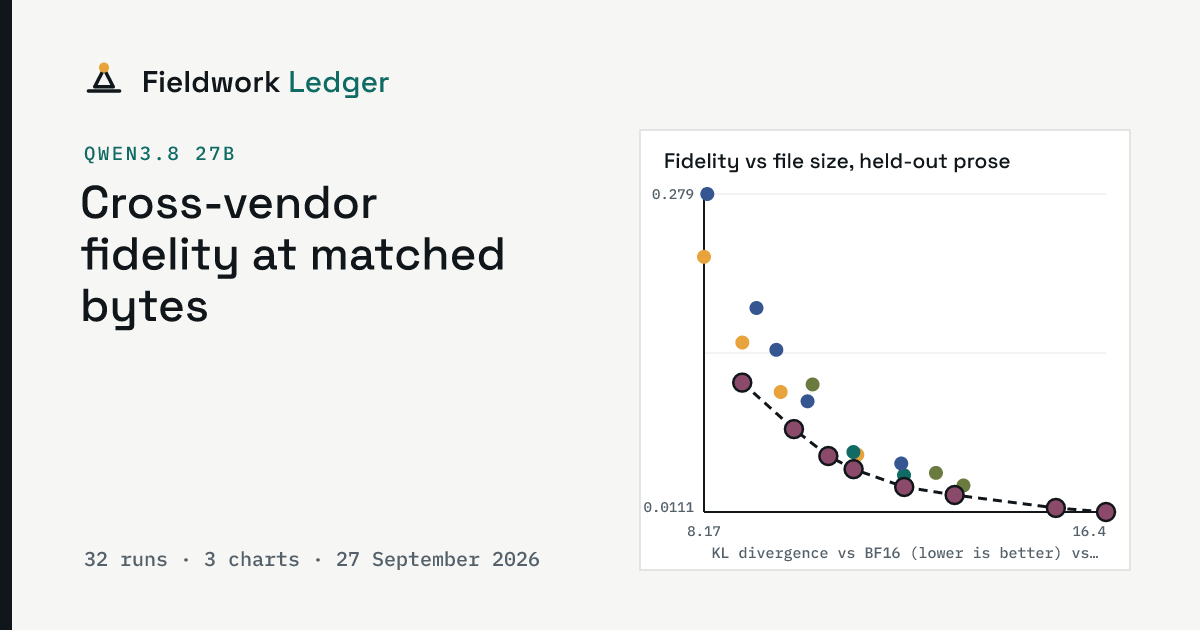
Any runner can perform the work.
Fieldwork Ledger preserves the evidence.
Why it exists
Research agents work across machines, sessions and tools. Their runs are rarely identical, their results land in different log files, and the reasoning behind a conclusion is hard to find again. The faster agents produce results, the faster that turns into a pile nobody can compare, review or build on.
Fieldwork Ledger gives distributed research one shared structure: the decision you are trying to make, the hypotheses you are testing, and every attempt at them — recorded the same way, whoever or whatever ran it.
What it does
Agents propose the next experiment from the campaign's goal, its constraints and everything already tried. Each idea becomes a stated hypothesis with planned variations — not a message lost in a chat.
Typed schemas give every parameter and measurement a unit, a direction and a meaning. Schemas grow as the research does, and fields you add later can be filled in on runs that came before them.
Success criteria are written down before the result. Finished runs keep what they ran with, replaced runs stay visible, and a successful process is never mistaken for a proven claim.
Compare runs against the baseline they should beat, chart the trade-offs, and publish a read-only snapshot of the findings at a private link — revocable at any time.
Who it's for

AI labs
Sweeps, ablations, quantisation ladders and benchmark contributions, run by many agents on many machines — held to one schema so the numbers still compare.

Industrial R&D
Materials science, formulation, process optimisation: parameters with units, the equipment and batch they ran on, and objectives that pull in different directions.

Research labs
Agent-led or agent-assisted: agents plan, run and record while researchers set direction and review. More experiments per week, each one reviewable later.
Product screens with illustrative data.
How it works
Product
A model, a process, an assay. It holds the context that outlasts any one question: recipes, inputs and the default schema.
Campaign
The goal, what would count as success, and the constraints that must not be quietly traded away — written down before the first result.
Experiment
A falsifiable hypothesis, the variations to try, and a schema that fixes what to measure, in which units, and which way is better.
Run
The exact configuration, typed results and the context it ran in — kept as it ran, wherever and by whomever it ran.
Runs become findings: charts, comparisons against the baseline you chose, and snapshots you can share.
Agents can create every level themselves. You set the direction and review at each one.
Bring your own agent
Give an agent the Fieldwork skill and it runs the research end to end: it opens the campaign, states the hypothesis, decides what to measure, registers every attempt, records the results and publishes what holds up. You set the direction and review the evidence.
It works in the harness you already use, with the models you already pay for or host yourself. Your prompts, weights and code stay where they are: Fieldwork sees only what your agent records.
Agent harnesses
Self-hosted models
Product names and logos belong to their owners. They are listed to show compatibility, not endorsement.
Features
Products hold the enduring context. Campaigns define a decision, with a goal, success criteria and constraints. Experiments state a testable idea and its planned variations. Runs preserve each attempt: exact configuration, lifecycle, typed observations and a snapshot of the context it was created in, so later edits cannot rewrite the premise under old evidence.
Parameters, observations and comparison context are declared with types, units, allowed values and optimisation direction. Values are validated when they are recorded. A schema extends without breaking what came before — add an optional field or widen an allowed list — and a field added later can be filled in on the runs that predate it, marked as added after the fact.
Runs are compared only where they were measured alike: same schema, same comparison context, same inputs. Each change is shown against the baseline you choose, with which way is better, and a comparison that is not like-for-like says why instead of printing a number.
Charts read live from successful runs, with every point traceable to its run and every exclusion listed. Colour by any typed field, or by groups of runs you define — ours against as-shipped, say. Draw the trade-off frontier through the runs you choose; Fieldwork never decides for you which runs are comparable.
Reusable definitions — training or corpus settings, recipes, file sets with hashes — are recorded once and referenced by the runs that use them. A referenced recipe is frozen; a change is a new version, and the difference between two is one command away.
The Fieldwork CLI and its skill are designed for coding agents in Claude, Codex, Cowork and similar environments. An agent binds a working directory to a campaign, reads the live goal and prior evidence, and records runs and results in structured commands — while its credential stays scoped to what you allowed.
Invite colleagues with roles from read-only to owner, and contributors to a single campaign or experiment. Agent credentials act for a person, never with more access than they have, expire when you choose and can be revoked at once. Every record says who — and which agent — made it.
Publish an experiment's findings as a read-only snapshot at an unguessable link: the comparisons you chose to lead with, the charts, and the runs behind them, grouped the way you set up. It never changes when the runs do, it is not indexed, and it can be revoked at any time.
Runner-independent by design
Scripts, agents, CI jobs, simulation codes and evaluation harnesses keep doing the work. Fieldwork records what they ran with and what they found, and links to the logs, artifacts and data they produced. No framework lock-in, and nothing to migrate.
Questions
No. Your agents and tools run them wherever they already run. Fieldwork records the plan, the attempt and the result; it never launches or stops a job.
No. People plan and review in the web app, and anything a script can do, a person can record too. Agents are where the throughput comes from; the record is the same either way.
Only members of your organization and the contributors you invite, each with the access you give them. Results leave only as a snapshot you publish at a private link, which you can revoke.
No tool can. Fieldwork makes a claim inspectable: what was intended before the result, what ran, what it measured, what was compared with what, and what was left out. It cannot guarantee that an external run happened or that an input was honest.
Free during the beta
Tell us who you are and what you want to track. Your place in the beta is confirmed at once, and your first shared results page is free.